How Do You Test and Adjust Hot Tub Total Alkalinity?
Understand the reading behind unstable pH, then test, adjust one variable, circulate, and retest with confidence.
Total alkalinity describes how strongly hot tub water resists changes in pH; it is not the same measurement as pH. Test total alkalinity, pH, and sanitizer together. When alkalinity and pH both need correction, follow the product label to adjust alkalinity first, circulate the water, and retest before deciding whether pH needs another product.
What Is Total Alkalinity in a Hot Tub?
Total alkalinity is the water''''s capacity to neutralize acid, which helps buffer pH against sharp changes. pH describes how acidic or basic the water is now; total alkalinity describes how strongly the water resists a change in that pH.
If you correct pH without understanding the buffer behind it, the result may not hold. Total alkalinity still does not replace a pH or sanitizer test, and an acceptable TA reading does not prove the water is ready for use.
Bellagio''''s existing water-care article states 80–120 ppm. The Model Aquatic Health Code uses a broader 60–180 ppm range in its public-facility context. Treat those values as context. The current product label, spa manual, and applicable local requirements control when they give more specific instructions.
Why Does Low Total Alkalinity Make pH Unstable?
Low total alkalinity can leave the water with less buffering capacity, so pH may move more sharply after use, refill water, or a chemical addition. Repeated pH corrections can then make the pattern harder to understand.
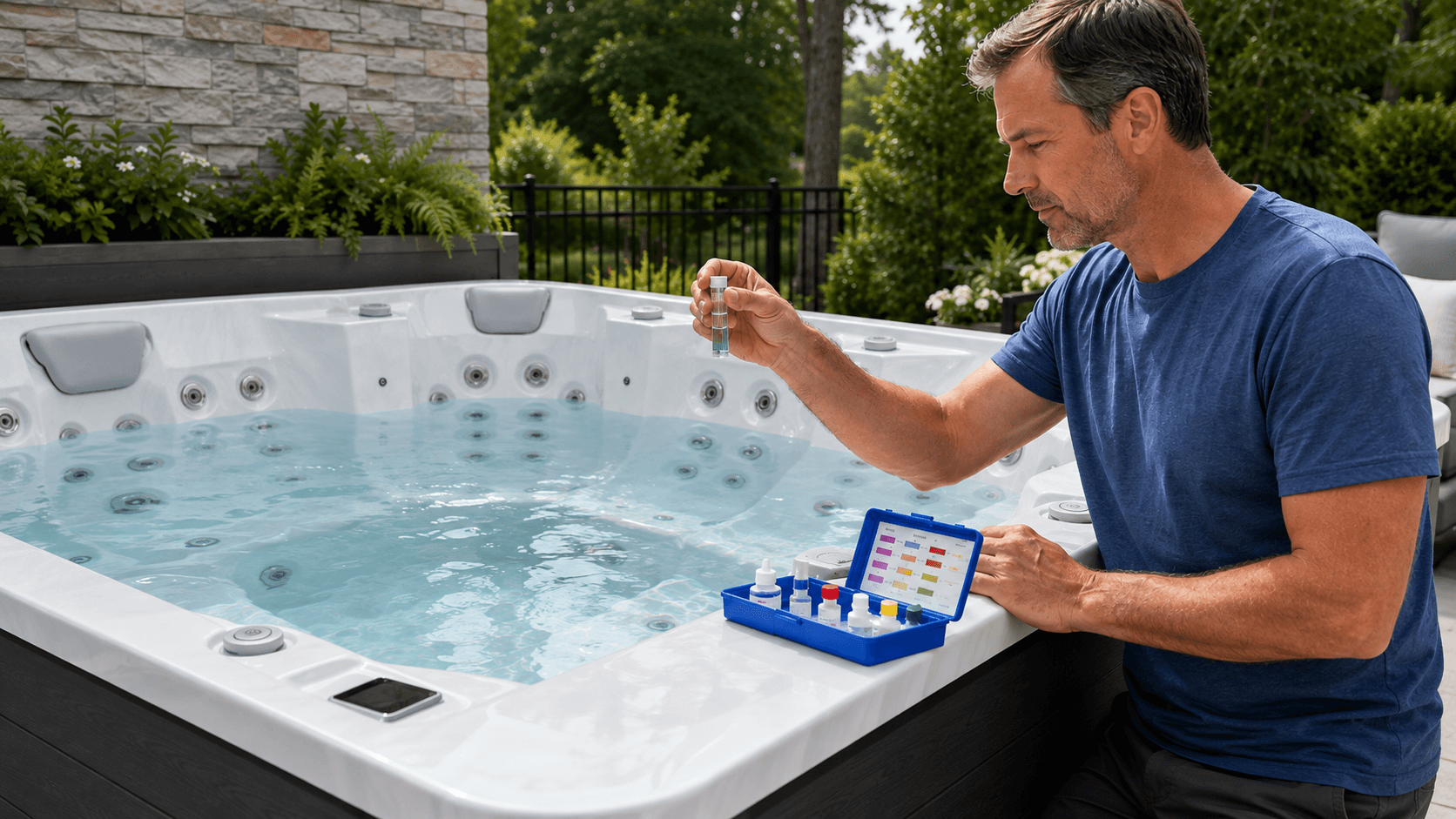
Confirm the reading before reaching for another product. Use fresh test supplies, follow the test timing, take the sample as directed, and write down the result. Note recent top-offs, a partial refill, heavy use, aeration, and every product already added.
A low TA result supports a label-directed alkalinity correction. Cloudiness, odor, foam, deposits, or discomfort need a broader water check because those signs can involve sanitizer, filtration, contaminants, or other balance problems.
Why Can High Total Alkalinity Make pH Hard to Lower?
High total alkalinity can make pH resist change, so one correction may appear to do little. Adding more product before the specified circulation and retest period can overshoot the eventual result.
High TA may appear alongside high pH, scale, or cloudy water, but those observations do not identify the cause by themselves. Test the full water set, check the filter and circulation, and review what has already entered the water.
When the confirmed TA reading is above the target for your system, use only the applicable reduction product as its label directs. MAHC discusses acid chemistry for public facilities, but its formulas are not a home-spa dose chart.
What Should You Test Before Adding Anything?
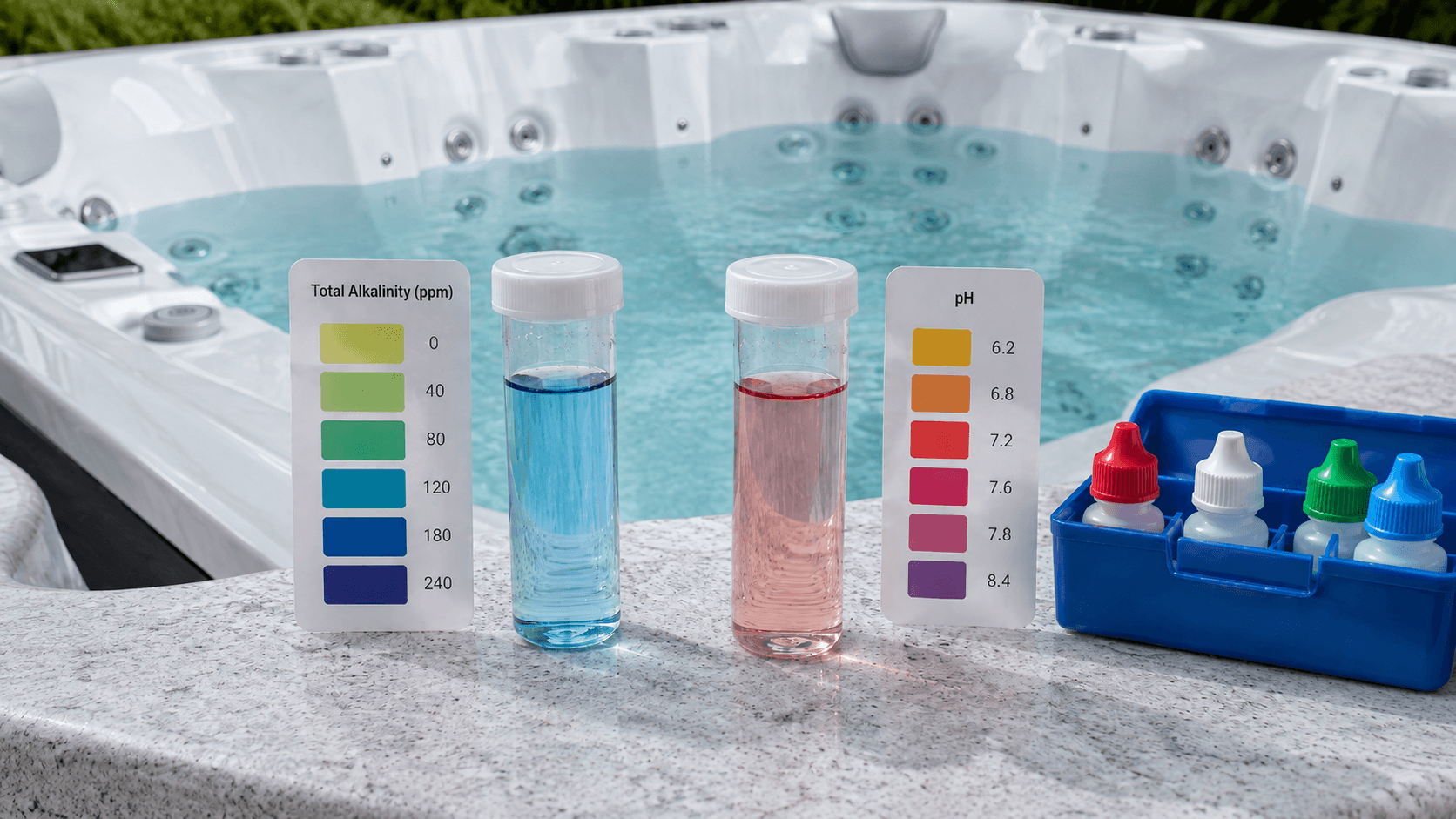
Test and record total alkalinity, pH, and sanitizer before choosing a correction. Add the water''''s appearance, recent use, and recent products to the same record.
Read the Water as a Set
| Reading or Observation | What It Tells You | Why It Must Be Checked |
|---|---|---|
| Total alkalinity | How strongly the water buffers pH change | Shows whether TA needs attention before another pH correction. |
| pH | The current acid-base condition | Shows where the water stands now; it cannot be inferred from TA. |
| Sanitizer | The current disinfectant reading | A correct TA reading does not show that sanitizer is adequate. |
| Water appearance | Cloudiness, foam, deposits, or visible debris | Reveals problems that TA alone cannot explain. |
| Recent changes | Refill water, heavy use, aeration, products, and filter work | Gives the result a timeline and prevents duplicate additions. |
CDC''''s general home-hot-tub guidance recommends pH from 7.0 to 7.8 and at least 3 ppm chlorine. Your sanitizer type, product directions, spa manual, and local rules may set a more specific target. Never use alkalinity as permission to soak when pH or sanitizer remains outside your system''''s instructions.
How Should You Adjust Total Alkalinity Safely?
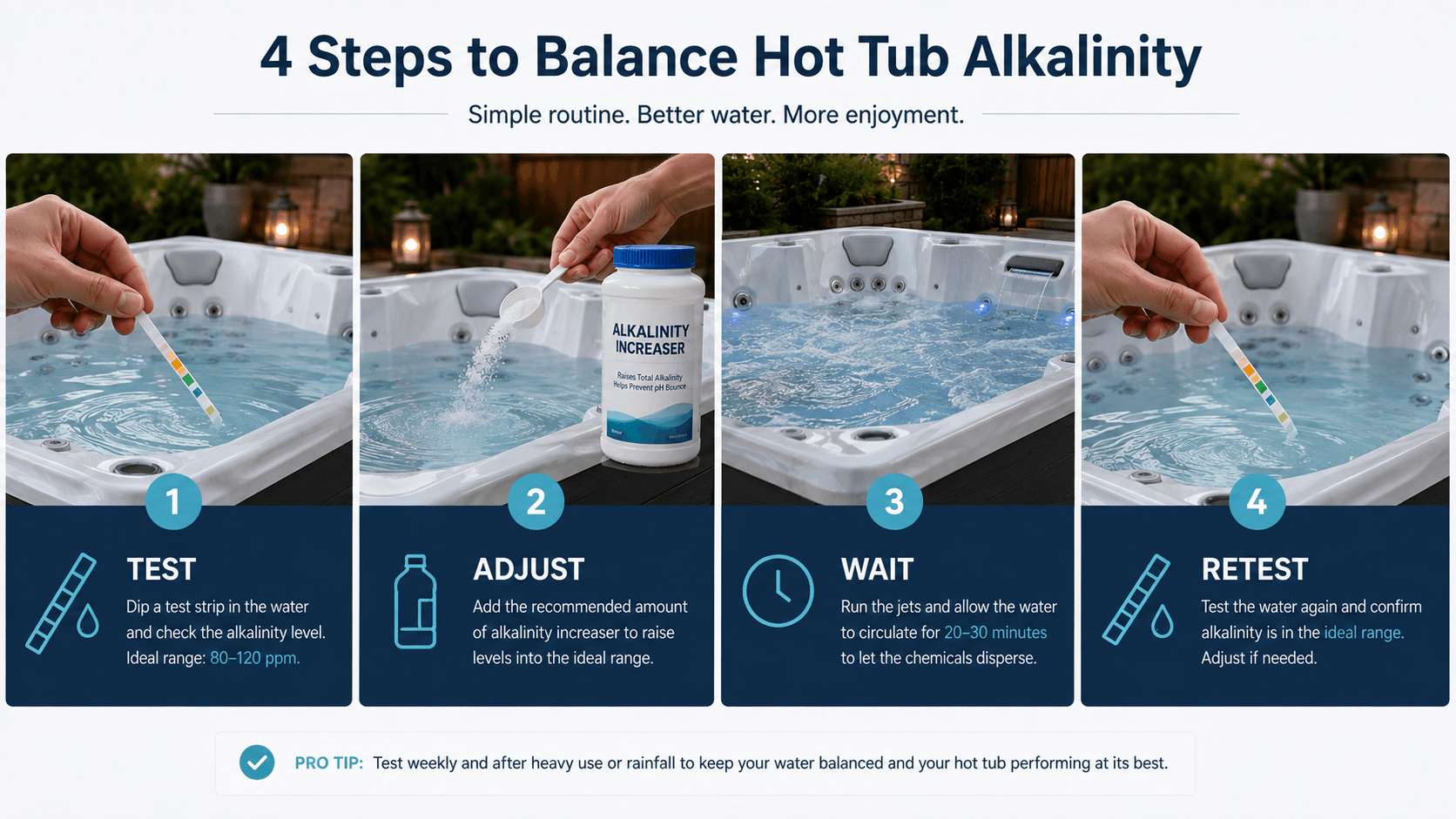
Use one measured, label-directed correction, circulate as instructed, and retest before making another change. The sequence matters more than speed.
- Test TA, pH, and sanitizer, then record the time and results.
- Confirm the spa''''s actual water volume and choose the product for the reading you need to change.
- Measure and add only the amount directed by that product label for your water volume and starting result.
- Circulate for the label or spa-manual interval, then retest TA and pH before another correction.
Do not estimate from another hot tub, combine products, or stack corrections before circulation and retesting. Product concentration, water volume, starting chemistry, and instructions differ. Never mix water-care chemicals, and keep each product in its original closed container.
How Do You Troubleshoot Unstable pH?
Use the pattern in your recorded readings to choose the next check instead of treating every pH change as an alkalinity problem. Work through one row at a time.
Troubleshooting Total Alkalinity and pH
| Test Result or Pattern | What to Check | Next Step |
|---|---|---|
| TA is low and pH changes sharply | Test method, refill water, recent additions, and product history | Use a label-directed TA increaser, circulate, and retest TA and pH. |
| TA is high and pH resists correction | Source water and repeated alkalinity-increasing products | Use the applicable reduction product by label, circulate, and retest. |
| TA is in target but pH is not | Sanitizer, aeration, bather load, source water, and recent pH products | Stop adjusting TA and address the confirmed pH or other cause. |
| Repeated tests contradict one another | Expired reagents, strip storage, sampling, timing, or technique | Retest with fresh supplies or have a dealer test the same sample. |
| Water stays cloudy, foamy, or deposits return | Sanitizer, filtration, circulation, contaminants, and water history | Pause use and follow the complete manual or professional route. |
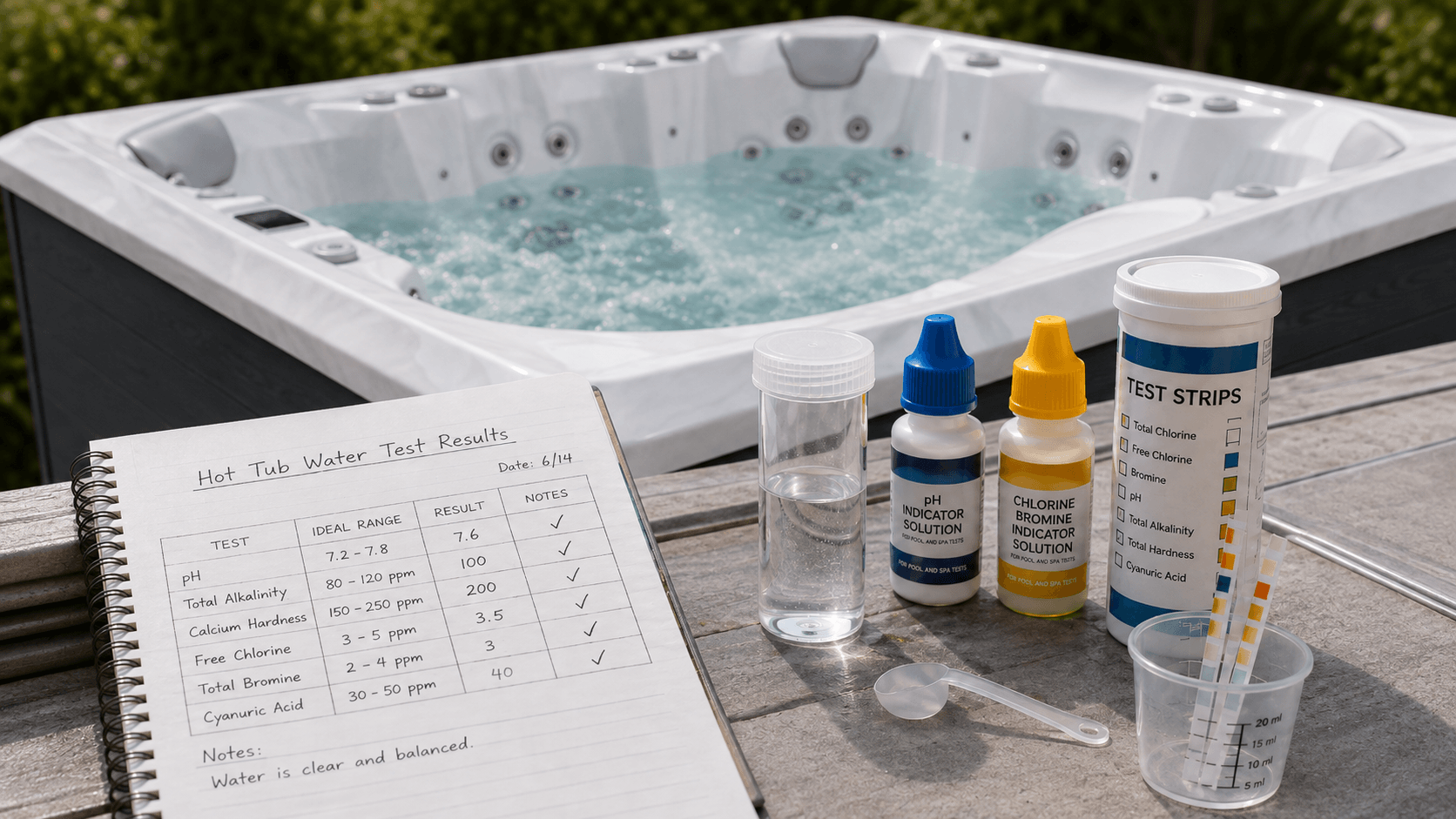
Avoid chasing a perfect number through rapid additions. A written log shows whether the reading is responding to a product, fresh water, use, or an unreliable test.
When Should You Stop Adding Water-Care Products?
Stop adding products when readings will not stabilize, you cannot reconstruct what was added, results conflict, or the water remains visibly abnormal. More chemical does not replace a reliable review of the process.
Pause use when pH or sanitizer remains outside your system''''s instructions, when the water stays cloudy, or when you cannot confirm the next safe step. Check the filter, circulation, manual, and labels. A dealer or qualified water-care professional can retest the sample and review the written history.
Draining and refilling may be appropriate when the manual or professional assessment calls for it. The decision depends on water history and system instructions, so this article does not impose a universal replacement interval.
How Does Bellagio Fit Into the Water-Care Process?
Use the exact Bellagio model and its documentation to turn general chemistry advice into a model-specific routine. Confirm actual water capacity before calculating a label dose, then follow the manual''''s filtration, circulation, filter-care, and refill instructions.
Keep the model identifier, manual, water volume, test log, product names, and quantities together. If readings keep moving, bring that record and a fresh sample to the Bellagio dealer or service contact.
Bellagio pages and dealer documents can vary by market and configuration. Confirm the manual and equipment for the spa you own rather than assuming one care schedule covers every model.
What Do Hot Tub Owners Ask About Total Alkalinity?
What Is the Best Next Step for Unstable Hot Tub pH?
Test TA, pH, and sanitizer now, record all three, and make only the correction supported by the confirmed readings and product label. Circulate and retest before changing another variable.
Use your Bellagio model, water capacity, and manual to plan the next step, or bring the record to a local dealer when the pattern still does not make sense.
Explore current Bellagio models, then ask a local dealer to confirm the configuration that fits your backyard and routine.
Find Bellagio Water-Care Support