Hot Tub Safety: Can You Soak in Cloudy Hot Tub Water?
Cloudy or foamy water is a warning to pause, test, inspect the spa, and correct the measured cause before anyone gets back in.
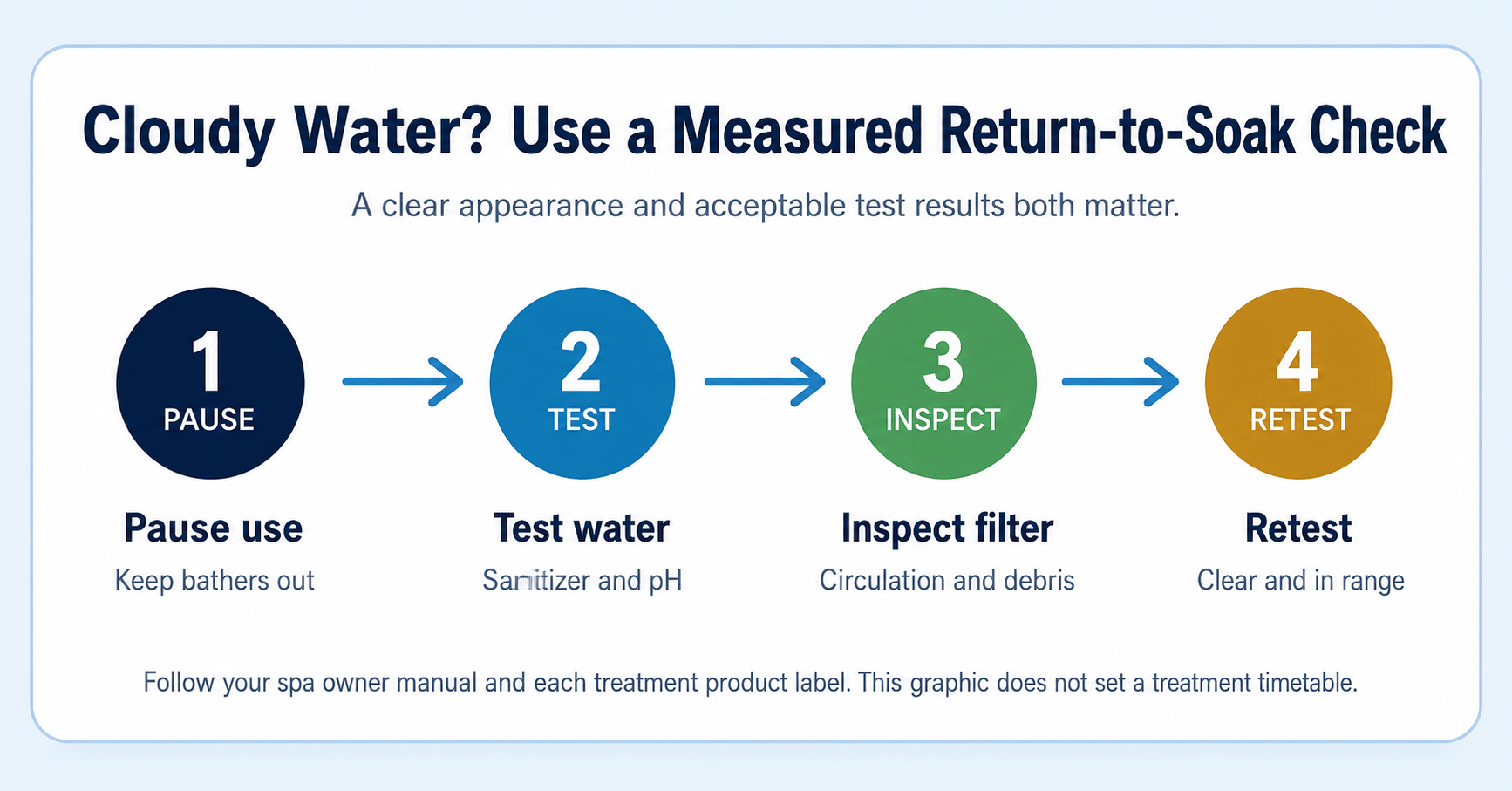
No. Do not soak in cloudy or persistently foamy hot tub water. Cloudiness can point to contamination, unsuitable water balance, accumulated residue, or restricted filtration. Keep bathers out, test sanitizer and pH, remove debris, inspect circulation and the filter, follow the spa manual and treatment-product label, then retest before use.
1. What Cloudy or Foamy Water Is Actually Telling You
Cloudy or foamy water means the spa needs attention, even though appearance alone cannot identify one cause. Clear water normally accompanies controlled sanitizer and pH readings and effective filtration. A dull, milky, or foamy appearance can develop when bather residue, debris, aging water, chemistry, and circulation problems overlap. Left uncorrected, unsuitable water can irritate eyes and skin and place avoidable stress on spa components.
Bather Contaminants
Soap, lotion, sunscreen, body oils, and swimwear detergent.
Debris & Organics
Leaves, pollen, dirt, and organic material.
Build-Up & TDS
Dissolved material, minerals, and water age.
Chemical Imbalance
Sanitizer, pH, or manual-specific parameters outside range.
2. Cause #1: Bather Contaminants
Every bather introduces substances that can promote foam and cloudiness. Soap residue, shampoo, lotion, body oils, sunscreen, and detergent left in swimwear enter the water during a soak. These surfactants reduce surface tension, while operating jets aerate the water and make the resulting foam more visible. More bathers and heavier use increase the contaminant load.
| Contaminant Source | Effect on Water | How to Reduce |
|---|---|---|
| Body oils and skin residue | Add organic load and can contribute to foam | Shower before entering |
| Lotions and sunscreen | Can create a persistent foam layer | Rinse before soaking |
| Shampoo and soap residue | Foams more visibly when jets operate | Rinse thoroughly |
| Swimwear detergent | Leaves surfactant residue in the water | Rinse swimwear in plain water |
3. Cause #2: Debris and Environmental Contamination
Leaves, pollen, dirt, and other organic material can consume sanitizer and obstruct filtration. Physical debris does not disappear when chemicals are added. Remove it first, then evaluate water chemistry. Anti-foam may reduce the visible foam layer for a short time, but it does not remove debris, correct chemistry, or prove that the spa is ready for use.
Skim visible debris
Use a fine-mesh net for leaves, grass, and floating particles.
Rinse the filter as directed
Inspect the cartridge and flow after a debris event.
Wipe the waterline
Use a spa-safe surface cleaner for concentrated residue.
Then assess chemistry
Test and correct only the verified condition according to the label.
4. Cause #3: Build-Up and High TDS
Spa water becomes harder to manage as dissolved material and treatment history accumulate. Chemicals, minerals, and bather residue remain in the water over time. Persistent cloudiness, recurring foam, or readings that will not stabilize can indicate that ordinary adjustment is no longer enough. Use the owner manual, test history, water condition, and local drainage rules to decide when a drain and refill is appropriate.
| Observation | Continue Measured Treatment | Consider Drain and Refill |
|---|---|---|
| Readings stabilize and clarity improves | Circulate as labeled and retest | Not yet indicated |
| Recurring foam or persistent cloudiness | Inspect filter, flow, and test method | When the manual calls for it or treatment fails |
| Known contamination event | Follow the applicable cleanup procedure | When directed by the manual or a qualified professional |
5. Cause #4: Chemical Imbalance
Cloudiness can appear when sanitizer, pH, or another manual-specific water parameter is outside its applicable range. Test before adding a product. For conventional chlorine or bromine hot tubs, CDC guidance calls for at least 3 ppm chlorine or 4–8 ppm bromine and pH from 7.0 to 7.8. Follow the sanitizer label, test-method directions, and the spa manual for alkalinity, calcium hardness, and any system-specific targets.
| Test | Applicable Starting Point | Boundary |
|---|---|---|
| pH | 7.0–7.8 | CDC guidance for conventional chlorine or bromine hot tubs |
| Chlorine | At least 3 ppm | For conventional chlorine systems |
| Bromine | 4–8 ppm | For conventional bromine systems |
| Alkalinity and calcium hardness | Check the owner manual | Not presented as universal Bellagio targets |
6. How to Get Rid of Foam Fast
Use a measured sequence instead of treating the foam layer as a diagnosis. Start with testing and physical inspection. Correct only the condition you can verify, circulate for the period stated on the applicable product label, and retest. The cause, filter condition, circulation, water age, and chosen treatment determine how long the work takes; no single recovery time applies to every spa.
Test first
Confirm readings before adding any product.
Remove debris
Net visible material and wipe the waterline.
Check circulation
Confirm normal flow and review error messages.
Maintain the filter as directed
Use the method permitted by the filter manufacturer.
Correct and circulate
Treat the measured condition and follow the label.
Retest or escalate
Retest before use; drain or seek help if the problem remains.
7. How to Prevent Cloudy and Foamy Water
Reduce repeat problems by limiting bather residue, testing consistently, and maintaining circulation and filtration. Shower before soaking, rinse swimwear in plain water, remove debris, wipe the waterline with a spa-safe product, replace the cover after use, and keep a maintenance log. Set shock, filter care, and water-replacement timing from test results, bather load, product labels, filter instructions, and the owner manual.
- Shower before soaking and rinse swimwear in plain water
- Adjust treatment from test results
- Inspect and maintain the filter as directed
- Remove debris and wipe the waterline
- Replace the cover after use
- Log tests, treatment, and equipment changes
Frequently Asked Questions
Keep bathers out, test the water, inspect debris, circulation, and the filter, then follow the applicable label and owner manual. If stable, clear water does not return, contact a qualified dealer or water-care professional.
Bellagio Info Center